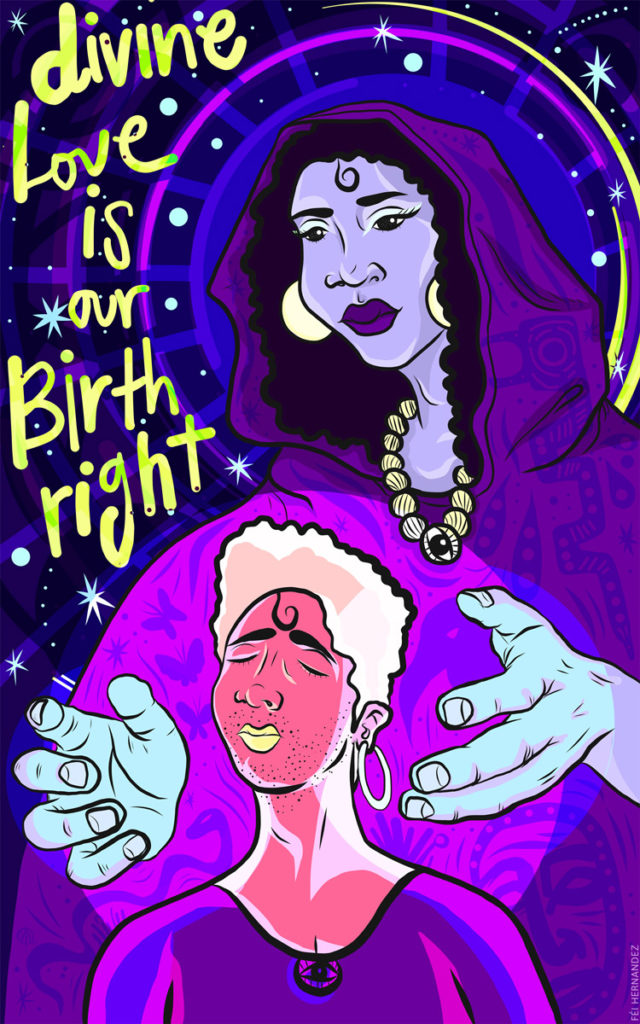
Pride in Faith: Empowering Queer and Trans Lives as Reproductive Justice
As we continue resisting, honoring and celebrating being our full selves this pride, those of us whose faith is also a part of our identity often grapple with the ways we’ve been shaped by our places of worship. The obsession our government and religious institutions have with dominating and controlling bodies goes against the Reproductive Justice tenet of bodily autonomy. At its core, Reproductive Justice is about bodily autonomy and possessing the agency to decide and determine who we are, and to name and speak for ourselves. In this moment, we must reach beyond tolerance towards empowerment to create an environment of safety for people to express their sexuality and gender regardless of what they believe.
As an ordained Baptist minister, I’m cautious about throwing the whole Black church community under the bus – but I do recognize the ways we can be politically liberal and socially conservative. We find these ways to further weaponize Black bodies, which have already been criminalized, demonized, and hypersexualized. We often attempt to silence, erase and shame people whose bodies are different, or who use their bodies to love differently. In doing so, Black people of faith further entangle ourselves in and replicate the same hate towards our bodies as has been done to us by the oppressor.
Family Formations
If sex is a God-given gift, we ought to be able to talk about sex in all of its expressions, in all of sexuality, in all of its manifestations. We have to be able to elevate the dialogue beyond just inclusion and affirmation; we have to talk about actually empowering folks in our communities.
A really close friend of mine grew up in the same church, and our families are very closely connected and deeply ingrained in church life. This friend’s cousin came out after living for a long time in the closet. They came out by changing their gender expression and came out as lesbian. Because my friend’s family was the leadership head of the church, there was a lot of shame directed towards the family, and so the family turned against her. She ended up taking her own life because there was a lack of acceptance, and there was a refusal by the family to acknowledge that this was one of our own.
In light of that fatal circumstance, some of the people in church began to say, “We need to love everybody. God says love everybody.” And that goes back to that “Love the sinner, hate the sin” narrative underlying KevOnStage’s recent comments. What does it say about a culture that has, historically from various African traditional religions, put queer folks in a category of being very close to the divine? And now the pendulum has completely swung the other way; those same people are seen as demonic and sinners.
Empowerment over Tolerance
When it comes to the idea that we can “Love the sinner, but hate the sin,” I think that is just tolerance, and tolerance is not the same as acceptance or affirmation. Beyond accepting people for who they are and who they say they are, the Black faith community needs to be looking towards empowering queer and trans folks. This means speaking out in favor of inclusion, advocating for LGBTQ+ justice in our communities, and seeing and elevating the gifts of queer and transgender folks.
Queer and trans people exist in our faith spaces. They hold leadership positions in our communities, they are oftentimes on the front lines of social justice movements, and yet there’s this willingness to subjugate queer and trans bodies to worse scrutiny than any other group of Black folks simply because of this colonized mindset that says, “Black, queer, and trans bodies are shameful, and should be invisibilized, or seen and not heard.” That really breaks my heart.
The Harm in Shame
In the church I grew up in, I recall the shame and the whispering around ”single unwed mothers,” rooted in the same place of “How dare somebody take control of their own destiny?” I wonder in those situations if they would have wanted the pregnant person to have an abortion. Because, again, there’s a cognitive dissonance among Black religious folks who are politically liberal, for the most part, but socially conservative. If news got out that someone had an abortion, then that becomes another stigma, another layer of shame. That shame is used in a very oppressive way, because it feels better to somebody’s soul and somebody’s spirit to be able to look down on somebody and say, “Thank God that ain’t me, or that’s not my child or my family.” It feeds the ego. At the same time, for families that are trying to deal with stuff behind closed doors, shame is rooted in fear of what they don’t understand, and a nostalgia for what it could have meant for them to express themselves fully as they are. That doesn’t mean that everybody’s gay or trans, but there are certain moments in life, certain life decisions, where people have an opportunity to live into who they are fully. Perhaps it was our parents’ parents that kept them from being able to live into their full selves. But it’s never too late. If people realize that we all have a closet that we need to come out of, I think the world would be a much better, much safer place.
When Black queer folks and Black trans folks live fully and without shame, it troubles something within the Black faith community. I think part of that troubling is in our family formations and in our community circles, where Black parents have these ideas about who their children can and should be and will be, and they put their dreams on those children. If those children turn out to be different than what they had hoped for or expected, Black families often shun them or turn their backs on them, not realizing that there is something about the freedom to name oneself and to live in one’s authenticity that they did not have a chance to experience in their own upbringing and their own life’s journey.
Black religious leaders who have a platform must begin interrogating their fear of talking about bodies, and take up the mantle of affirming, accepting, and also empowering Black queer, and trans folks. As the beloved community, our lives and our futures depend on it.
Resources
If you or your kin need support or have spiritual questions about pregnancy or reproductive decisions, call 1-888-717-5010 to be connected to compassionate Spiritual Care Counselors at Faith Aloud.
Visit Church Clarity to access a crowd-sourced database of Christian congregations scored by policies that impact LGBTQ+ people and women in Leadership.